




At Lirum Larum Leg, we put genuine effort into assisting children's guardians so they can easily and clearly create inspiring environments where play becomes a source of hygge, fun, presence, and immersion.
Therefore, it is with joy that, in cooperation with experts Fie Hørby and Mie Kaae from Blackbird Institute, we will provide you with weekly tips and inspiration for life with children. Below, you’ll find Mie’s concrete tips on how you can easily create breathing spaces in a busy everyday life.
Why are breathing spaces important?
"The most important thing we can give and offer our children today is breathing spaces of presence and connection. It's in these moments they really feel themselves and us! We are all born with the ability to be empathetic and present, but a busy daily life filled with stress and guilt counteracts our natural ability to be truly present. Therefore, the best we can do for our children is to create some breathing spaces in everyday life where we play together, 'be' together and relax, so we can find our essence.
Being together and feeling community makes life a joy, and what many don’t realize is that emotions are contagious
The more present we are as parents, the less effort children need to obtain the most essential thing they crave from us - our presence and connection. Emotions spread, and when we offer our children our calm presence, we make them feel safe and more calm. This way, we will also less frequently encounter children who behave demanding, whiny, or bothersome. When children act like this, it's always a cry for genuine and attentive contact.
Often what our children want from us is also what we need the most ourselves
Most children need to transition from institution to home without too many words. Many of us know this from our own experiences. A gentle transition can be lounging on the sofa or the floor, starting by doing nothing other than lying closely together. You may gently stroke your child's feet, face, back, or scalp until calmness descends, and you hear their breathing deepen.
The worst that can happen is you both drift off for a moment, becoming softer and slower in both mind and body - or find yourselves laughing together. Often that’s exactly what’s needed for our children to ground themselves after a long day and find what they want to do at home. What also happens is that we slowly connect with one another.
From neurological research, we know today that our nervous systems are interconnected, and that our children regulate their nervous systems within ours. So, when our nervous system is calm, our children's nervous systems adjust accordingly — and naturally vice versa. Physical touch is a shortcut to soothing our children and our own nervous system — and the younger the children, the more they need physical touch from us.
Concrete tips and inspiration for creating breathing spaces in everyday life
 |
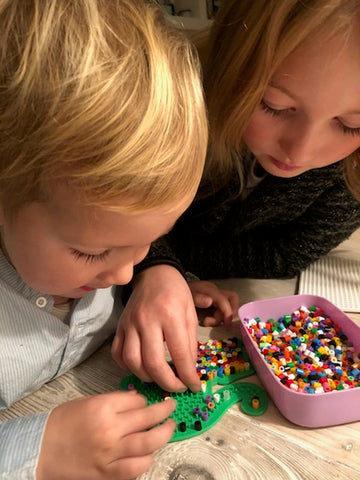 |
TIP #1: Have markers, beads, paper, or modelling clay on the table along with flowers and candles
A great tip for an everyday breathing space is to have a ‘creative station’ in the form of a tray or platter on the dining table with items like beads, markers, crayons and paper, inviting you to play together after eating. The bonus is that the kids linger longer at the dining table, and the conversations often reach deeper levels when we physically immerse ourselves and connect with ourselves and each other. You can swap out the markers, beads, etc. depending on what you find fun and inspiring. Everything works. The trick is to make it attractive, so you create a breathing space for everyone in the family.
”Sometimes all five of us draw and tinker for an hour after dinner. It’s the best time together, and we've done it since the older boys were very young. Now they're 10 and 12 years, and they still want to join. The older ones often lie on the floor drawing while we sit with the little one, who’s 2, doodling fish, animals, and faces. It has sparked many great conversations over the years, as there is time and calm to talk about what is easy and what is hard. Yesterday we talked about what humility really means. The other day, we discussed how some of the first animals on land looked. We tried to draw them as we imagined them. Above all, it brings calmness to all of us, and nobody asks for phones, computers, or iPads. It has become a ritual for us, and I love finding beautiful and fun things for our tray that always sits on the table” - Anna, mother of three
PS: To be present in the conversation and play with our children, it requires us to set aside the role of disciplinarian and meet the children as fellow human beings. It is often much more fun to be an adult that way."
- By Mie Kaae, February 6, 2018

Blackbird Institute is a family therapy institute offering education in relational competence, family counseling, and family therapy. The institute was founded by Fie Hørby and Mie Kaae.
Fie Hørby is a psycho- and family therapist and the mother of Rumle, 16 years, Liv, 11 years, and Isak, newborn. She has written the Bestseller “Drop Opdragelsen!” and the book “Om teenagere – for forældre”.
Mie Kaae holds a master's degree in psychology and communication, is the author of the book "What Do You Really Want?" and is trained in dance and body therapy. Mie is also a mother of three - Marvin, 12 years, Linus, 10 years, and Havanna, 2 years.
Read more about Blackbird Institute here


